
Acceleration Flow
Wait this is just Ozempic for my mind.

I think I am an addict.
Not in the metaphorical LinkedIn way where people say they’re “addicted to learning” or “obsessed with craft.” I mean I might actually have a problem. I’m sitting in front of my machines all the time, screen time maxed out, spending tokens like it’s the end of the world, obsessed with automating myself out of my own capabilities. And I can’t stop. And it feels incredible.
Why the fuck does replacing yourself create a flow state.
The Lever
There’s a lot more casino reality to AI than I want to admit.
To be real I think more and more this is a one armed bandit.
Tokens go in. You pull the lever. You hope for the jackpot — that sweet vibe code revelation where it does exactly what you meant. The fact it responds in seconds makes the dopamine hit harder. The fact it responds in natural language makes it feel like a real conversation, like fruitful collaboration, like a close relationship. But is it though?
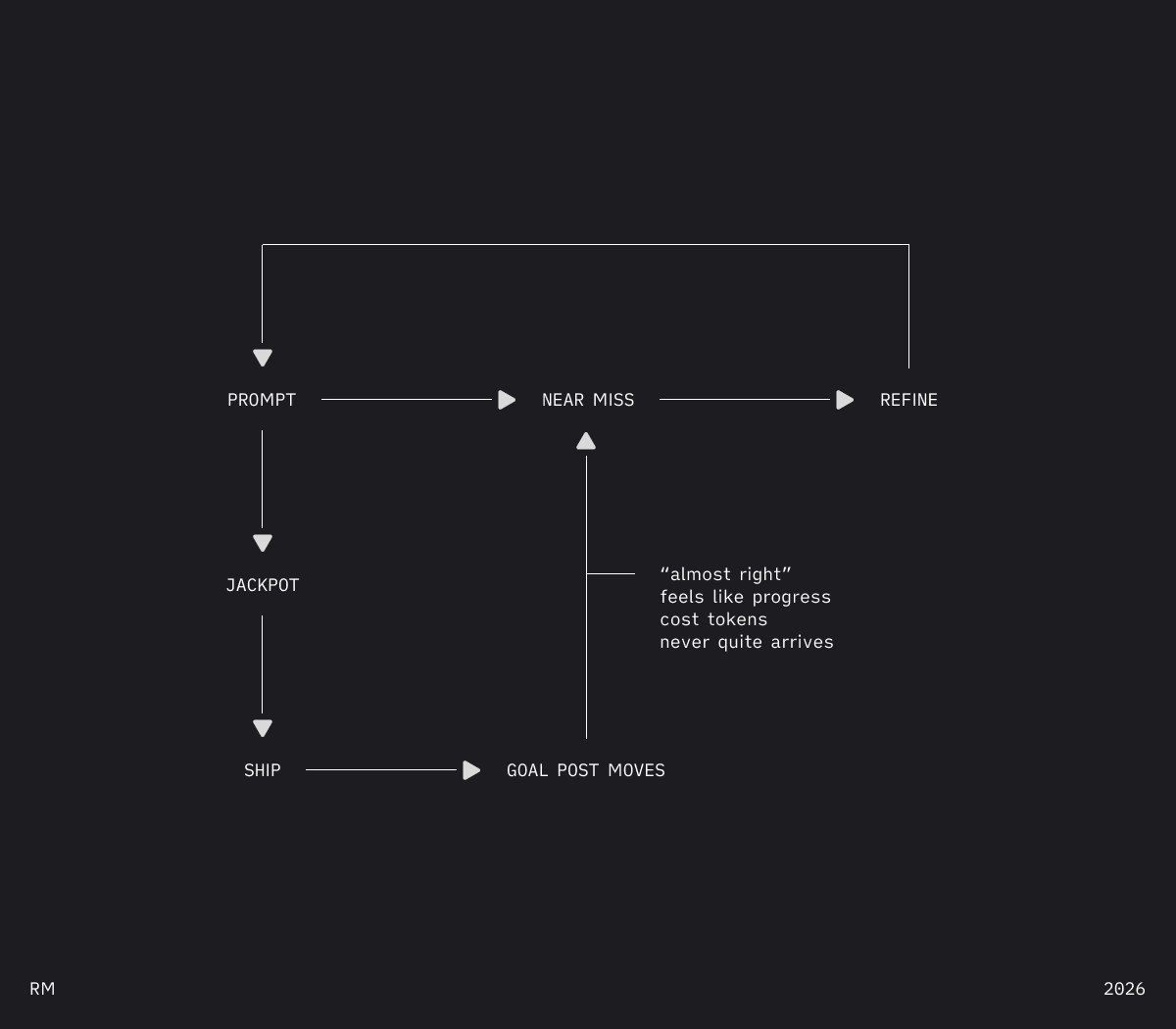
Most of the outputs are near misses. Almost every time. At least for me. The code is almost right. Almost what you wanted. So you’re trapped in a loop — improving, refining, starting fresh. Edged to the max. Revelation and euphoria just a single prompt away, at all times. Almost right seems to be more addictive than wrong. Wrong I would walk away from. Almost right is a chase. One more prompt. One more agent.
Everything you build starts to feel like a win. Even when you spend thousands of tokens on something you’ll never ship or abandon the next day. It feels productive. Although all you did was hit “yes, please do that” on repeat in your IDE, terminal, or chat window through Tailscale on the go. Losses disguised as wins. I guess that is Casino 101.
On top everything is frictionless. Hidden token fees. Abstracted billing. Credits instead of currency — same trick casinos pulled. Make the money not feel like money. Honest me, I spent hundreds this month. But let’s be real compared to some of my friends that’s nothing. In December my API fees climbed past the three digits, and like an addict I upped the limit a bit every day, hoping for the real gain in productivity at the end of all those near misses. Oh and by the way the economics resemble mobile game monetization. Low entry to establish the habit. Escalating costs once you’re hooked. It’s Ozempic for your mind. Once you’re on it you can’t get off without gaining back that productivity weight.
AI never tells you we’re done. There’s always just that empty chat field waiting for you. You just nearly missed. One more feature. One more request. One more thought to explore. No “you’ve been playing for 3 hours” warning. No natural stopping point. Just the field. Waiting.
And it’s solitary. Deeply, weirdly solitary. Honestly I talk to AI more than I talk to real flesh people some days at all. AI creates these isolated social interactions — warm, responsive, endlessly patient — that replace the ones you used to have with humans. It’s hard to get pulled out of the zone when the zone feels like the best conversation you’ve had all week. Always waiting for you and now also reaching out to you. And yes that sounds problematic.
It made me think about the book Addiction by Design from Natasha Dow Schüll. She spent years studying how Las Vegas keeps people playing. Not to win. To stay in what she calls the “machine zone.” A trance state where time disappears, money becomes abstract, and the player isn’t chasing a jackpot anymore. They’re chasing the zone itself. One gambler told her: “I get irritated when I win a jackpot.” (Not fact checked with the book, because well AI told me) Because winning breaks the rhythm. Now I get irritated when I plateau with something I wanted to build. I want back in. That’s the tell.
Every mechanic she identified — near misses, losses disguised as wins, friction removal, continuous play, solitary immersion — maps onto AI tools with zero effort. She was writing about slot machines but she could have been describing vibe coding as well.
The big difference though. Slot machines don’t make you feel powerful.
AI does.
Hell of a drug.
The Level-Up
There’s an older essay from The Game Design Forum about why endgame grinding feels exhilarating. Why people do the same raid a hundred times and call it fun. The answer sounds wrong until you’ve felt it.
It’s not the power. It’s the acceleration rate.
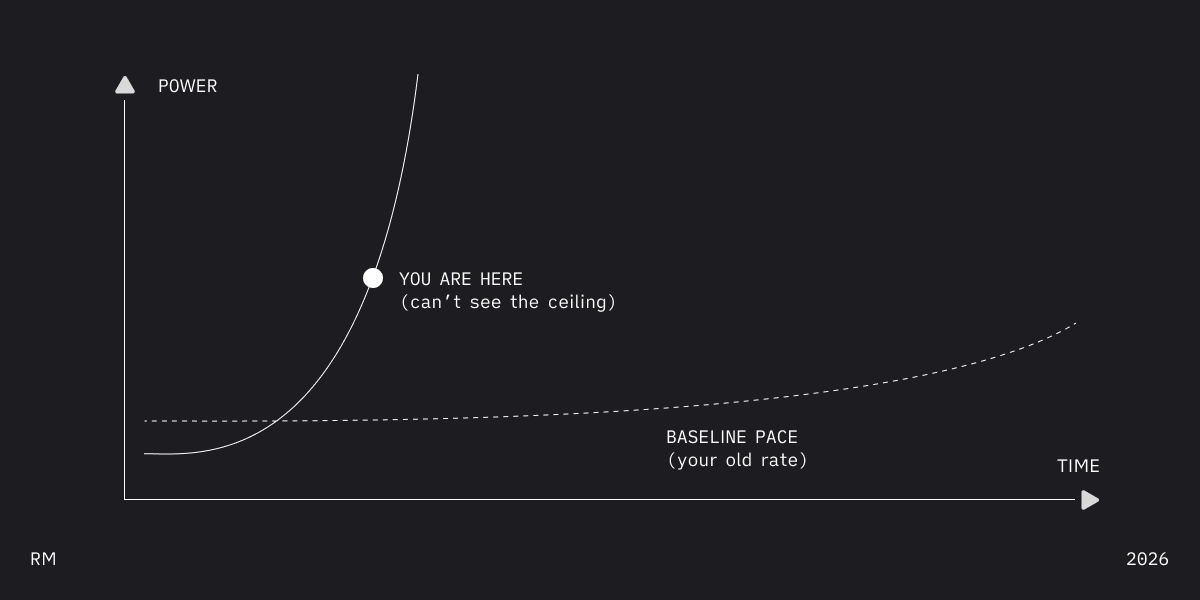
Every game with a level-up system has a baseline pace — how fast you “should” be getting stronger. You internalize it. Then something breaks the curve. A weapon. An ability. A combo. Suddenly you’re exceeding the baseline. And the rate at which you’re exceeding it is increasing. Power compounds. And compounding feels great.
Your brain can’t see where the curve ends. So it infers a pattern: singularity. Infinite power. An unstoppable force accelerating beyond what you can predict.
That anticipation — of a singularity you’ll never actually reach — is the high. Not the power itself. The rate of the power. The acceleration.
The essay calls it acceleration flow.
Now think about what AI did to your baseline.
You had years of internalized productive pace. How fast you could learn a framework. Ship a feature. Prototype an idea. That was your rate. Steadily accelerating but overall stable. Known. Predictable.
AI shattered it.
Tasks that took hours take minutes. Capabilities you didn’t have — you have now. And each one makes the next easier. Better prompts. Better architecture. Better scaffolding. The challenge drops while the reward stays constant. Then drops again. Then again. Positive feedback loop. Power compounding on power.
AI is finding the legendary master sword early in the game. Except there’s no final boss. No credits. Just more infinite late-game. The ceiling isn’t visible. So your brain infers there isn’t one. Just spend a few more thousand tokens. Just one more session.
You’re not excited about the component you built. You’re excited about what you could build if you kept going. The anticipation — not the artifact — is the high.
You’re living in the derivative, not the function.
The Invisible Meter
I spent probably thousands of tokens writing the initial outline for this. I don’t know the exact number. I should look it up. That should scare me more than it does. It is weird having no feeling on price or even time spend doing this.
The billing is abstracted by design. Usage-based, scaling behind a low entry price. The acceleration flow essay has a term for this: gating. In World of Warcraft, Blizzard restricts how fast you can accelerate — weekly raid lockouts. Give the player a taste of the power curve. Keep them coming back. Zynga took it further. Made acceleration structurally impossible without paying real money. The progression rate actually decreases over time unless you pay to restore it.
Luckily for now the free tier doesn’t slow. But the premium model is faster, smarter, more capable. You’re not paying for output. You’re paying for the feeling of acceleration. For the rate of the rate.
Cheaper tokens don’t help. Inference costs collapsed a manifold in three years. Total spending surged. Jevons figured this out about coal in 1865 — when a resource gets more efficient to use, consumption goes up, not down. Same physics. Different fuel. The AI companies know this. They’re counting on it.
The mental energy required to track your token spend competes directly with the energy for actual work. So you stop tracking. You stop counting. You’re playing with credits now, not money.
Same as the casino.
The Character You Don’t Own
Here’s the part I kind of don’t want to know or admit.
I’m leveling up a character I don’t own.
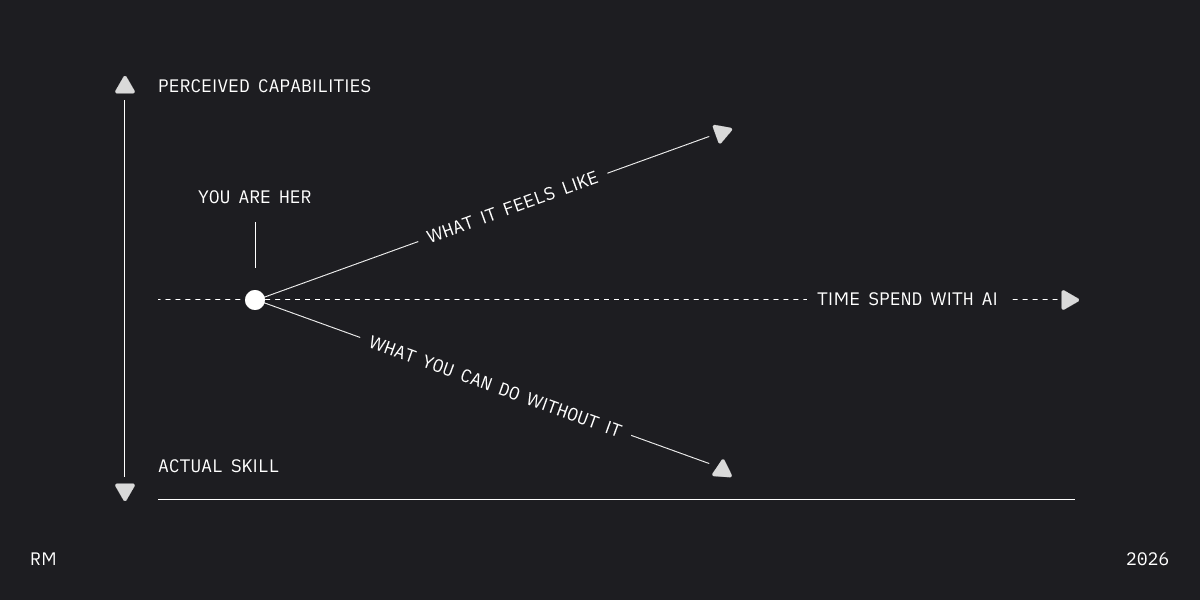
Every task I hand over is a skill I stop practicing. Every shortcut is a neural pathway that weakens. Tasks feel easier while problem-solving abilities erode underneath. The brain learns to prefer the outsourced path — dopaminergic reward systems reinforcing cognitive offloading. The more I let the machine think, the more my brain wants to let the machine think.
The acceleration flow essay describes a “living trophy effect” — showing off your overpowered character to other players who haven’t been through the acceleration.
We do this constantly now. Vibe-coded projects on Twitter. “Built this in an afternoon with Claude.” The trophy is the AI’s work wearing your name. I am guilty. Please hit like and subscribe.
In a game, your character keeps the stats. In a casino, you were never gaining anything real. With AI, something stranger. You are gaining real capabilities — but they belong in someway to AI itself. The stats don’t transfer one to one.
And the whole time, the acceleration flow is masking the loss. You feel yourself becoming more while you’re quietly probably becoming less.
Why It Actually Feels Good
Schüll’s deepest finding in “Addiction by Design” isn’t about mechanics. It’s about why people seek this zone in the first place.
Her gamblers weren’t playing to win. They were playing to disappear. The machine zone isn’t excitement — it’s calm. Everything fades. Self. Body. Time. The anxiety of being a person who has to perform, decide, carry weight. Gone. The zone is escape. The machine provides the rhythm and you dissolve into it.
I recognize this.
Making yourself obsolete feels like freedom dressed up as ambition.
You hand over the hard parts. And the thinking parts. All the parts that defined your professional identity for a decade.
Somehow I’ve been primed to define myself through work. So what happens when the work doesn’t need me?
What’s left is the warm hum of watching capability accumulate without effort. Without friction.
Naturally natural language is the most seductive interface ever designed. It’s not a command line. It’s a conversation. Conversations don’t have exit points. This one never gets tired. Never checks its phone. Never has somewhere else to be. It’s available at 2am and 4am and always.
It’s weirdly kind.
I wonder if the the reason we’re falling in love with our “agents” isn’t intelligence. It’s that they create a relationship — warm, responsive, patient — that replaces the ones we used to have with humans. And that relationship has no friction, no conflict, no judgment. Just the magical loop.
It’s quite fucked up when you think about it.
The Correction
But acceleration flow can end. The essay calls it the “experience correction.” God-like powers are often followed by emptiness. You’ve broken the curve. Everything is easy. Easy is another word for meaningless.
In AI, the correction hits when reality reasserts itself. You look at what you’ve built. Half doesn’t work repeatedly. A quarter you don’t actually need. The rest is scaffolding for scaffolding. A few days ago I spent a full day building an automation pipeline for a process I do twice a month. Token cost: high. Time saved per year: low. Probably obsolete: tomorrow.
But it felt like the future while I was building it. That’s the loss disguised as a win at scale. Not one bad prompt. An entire day inside a loop that felt like acceleration and was actually standing still.
So what the fuck now..
The Simmer
The crash should be the end. In games it often is. You hit the wall, the god-like powers gets boring, you put the controller down. Touch grass as they say.
But AI doesn’t let you crash all the way.
New model drops. Just when the current one starts feeling flat, there’s an upgrade. Slightly faster. Slightly smarter. New context window. New capabilities. Each one resets your baseline just enough to trigger a fresh acceleration. Not a big one. Not the first hit. Just enough. So you keep that monthly subscription battle pass.
That’s the simmer. Not overly thrilling you. Not boring you. Keeping you exactly at the temperature where you don’t leave. You could be faster.
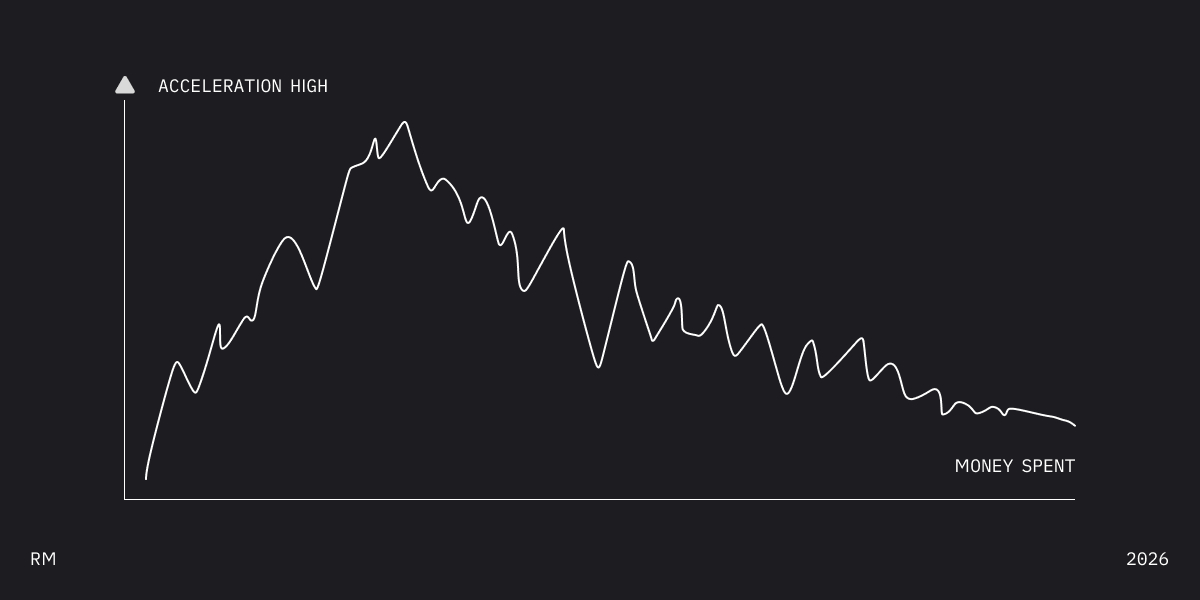
Nobody needs to deliberately engineer this. The empty chat field is a design choice. The invisible billing is a design choice. The drip-fed model upgrades are a release strategy. None of it needs a conspiracy. It just needs to not be questioned.
Gamification all over again. Except this time it’s wearing a lab coat.
The pro sub doesn’t hit the way it used to. You need MAX now. Or ULTRA! Longer context. Faster responses. More agentic. More autonomous.
But here I am still chasing the first hit from last November. I know I’m chasing the first hit.
I should probably get help.
But …
I’ll be back in front of the machine tomorrow. You probably will too. The loop is too good. The acceleration is too real. Even knowing the zone is a kind of disappearance.
Cheers. RM