
On Ragequit and Vibe Coding
Why I or your customers are building it ourselves and what that means for softwear

Same conversation keeps happening in every group chat I’m in. Someone complains about a tool they pay for. Someone else goes “I just built my own version last weekend.” Three more people share their stories. Everyone’s ditching subscriptions and shipping their own stuff before dinner.
Why the fuck do I pay for this when I could just build it myself?
That question stopped being rhetorical.
The coyote problem
A lot of SaaS companies are Wile E. Coyote. Ran off the cliff, still running. Haven’t looked down yet. (Shoutout to Noah Raford for inspiration)
Here’s the vulnerability audit:
If your product is an API with a login page, you’re maybe fucked.
If your value could fit in a markdown file, you’re maybe fucked.
If users keep asking why your thing doesn’t work with their stuff, you’re maybe fucked.
If your core feature is a weekend hackathon project, you’re maybe fucked.
The moat was friction. Building things yourself was annoying, so you paid someone else. That friction is dissolving.
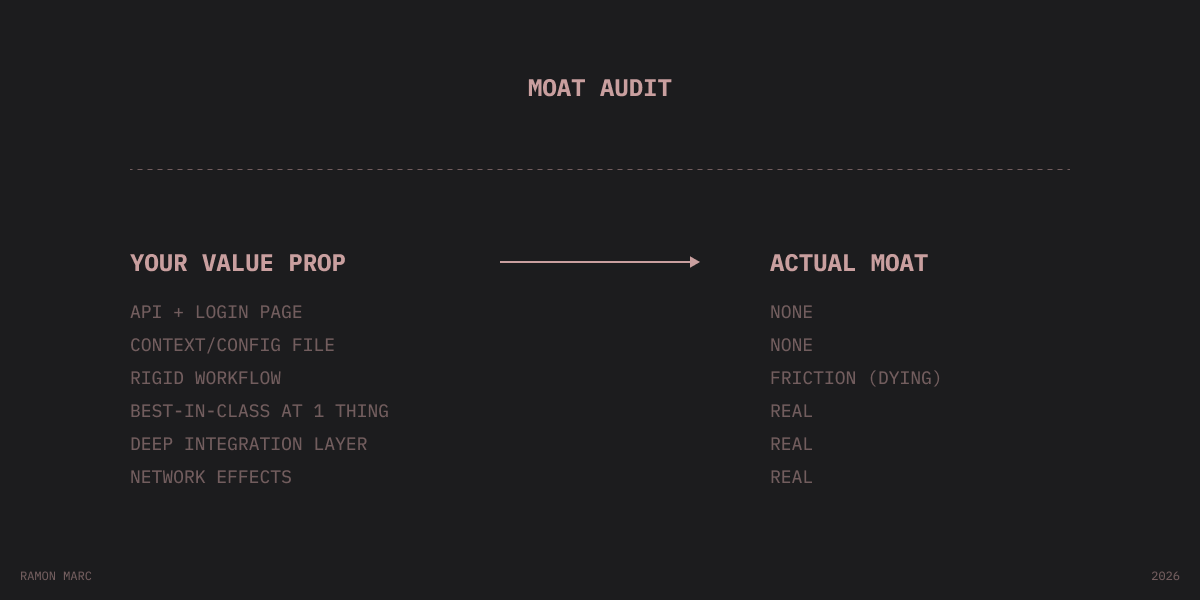
Ask yourself: If someone described your product's core value in a prompt, could Claude build a working version in an afternoon?The economics flipped
We used to design for the average user. Good enough for most, most of the time. Users shaped themselves around tools because they had no choice.
Now they have a choice.
$20/month × 12 = $240/year for software that doesn’t quite fit your brain/flow or needs. Or $50 once for exactly what you need, built around how you actually work.
The math only goes one direction. And every month the build cost drops.
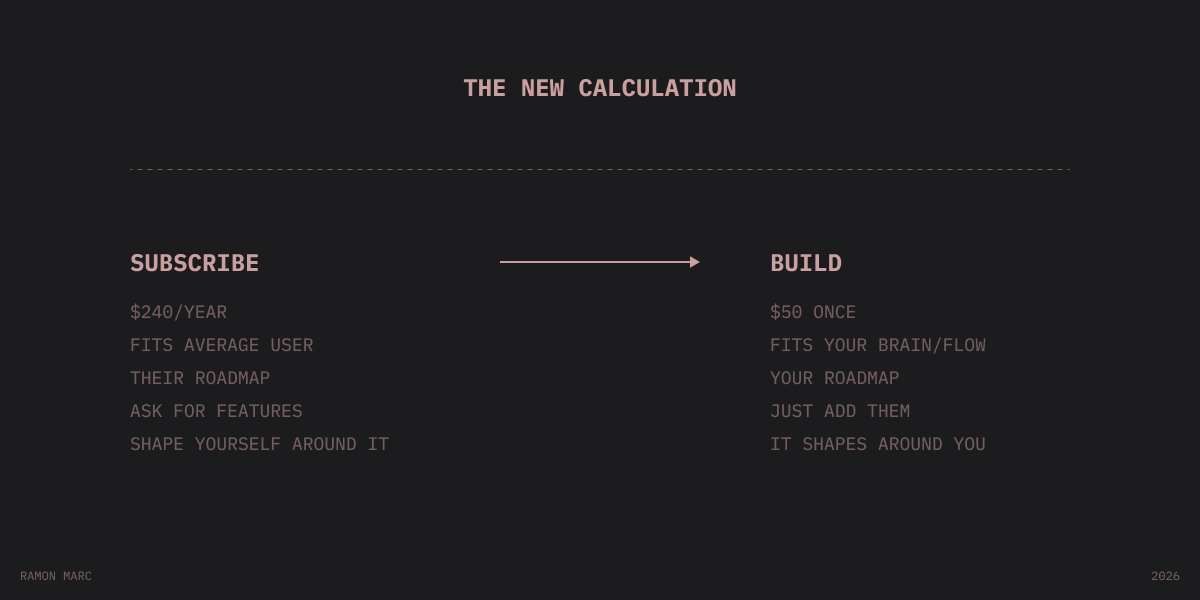
Ask yourself: What's the annual cost of software that almost works? Count the workarounds, the exports, the "I wish it could just..."The skill shift
Coding became a conversation. But that’s not the interesting part. Everyone’s heard “PMs, Designers, etc can code now.”
The interesting part is who has the best ideas, best insights, best understanding for what to build.
People who sat in sprint planning for years. Who watched engineers but also watched sales calls, customer support tickets, ops fires. They saw the whole system. They know where it breaks. They know what’s painful. They just couldn’t execute before.
The unlock isn’t technical ability. It’s that the people with the most context about real problems can now build solutions directly. No translation layer. No waiting for prioritization.
The more exposure you had to different parts of the business, the longer your build list is right now.
The people with the most cross-functional context are about to ship a lot of tools. Not because they learned to code. Because they finally can.The garbage problem
Most of what we’re building is bad. We need to talk about that.
Every time you use an LLM to solve a problem you build a supercar to get from A to B. Tomorrow another car. Next week another. Eventually: shit, I need a bigger garage. Single-use plastic software piling up everywhere.
The tools collapsed the time between “I have a problem” and “I’m building a solution” to zero. But understanding what you actually need still takes time. We’re skipping it. Building the wrong thing fast, rebuilding it slightly different, over and over.
Here’s what building well looks like: You spend more time in the problem than the solution. You write down what you need before you prompt. You ask whether this is a tool that grows with you or just another car for the garage. Most people skip all three. But the feature we are heading is intent is just another function call.
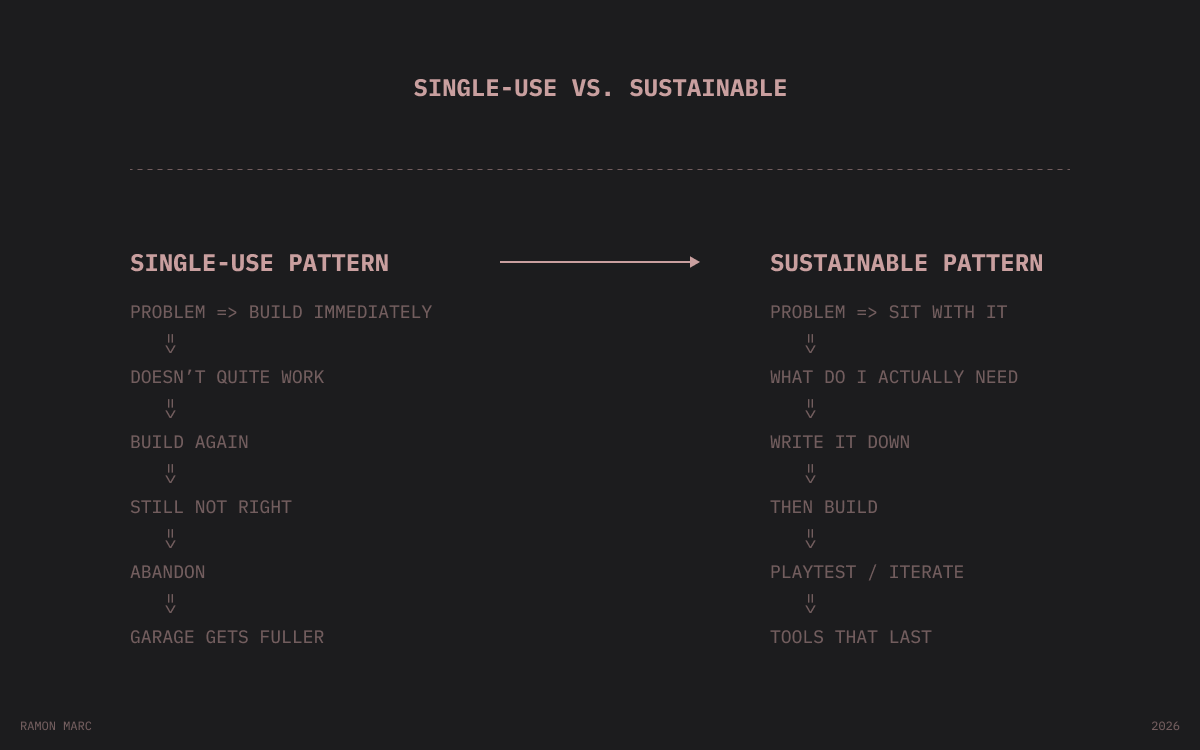
Ask yourself: How many tools have you built in the last 3 months? How many are you still using?The spellbook
The people who are actually good at this have way more exposure to how others think. Best learning happens as you read in private group chats where people share real prompts, show failures, talk through what they’re trying to do. Every conversation expands what you think is possible.
MidJourney on Discord was perfect for this. See an image, prompt’s right there. How people thought, what worked, what didn’t. Collective spellbook everyone built together.
Most tools hide the process now. Social media shows output, not sauce. People reinvent wheels because they never saw the better way.
Prompting is a muscle. Develops through exposure. Without it you’re just flailing.
Ask yourself: Where are you learning how others think? If the answer is Twitter/LinkedIn, you're seeing output, not process. Find better rooms. FAST!What survives
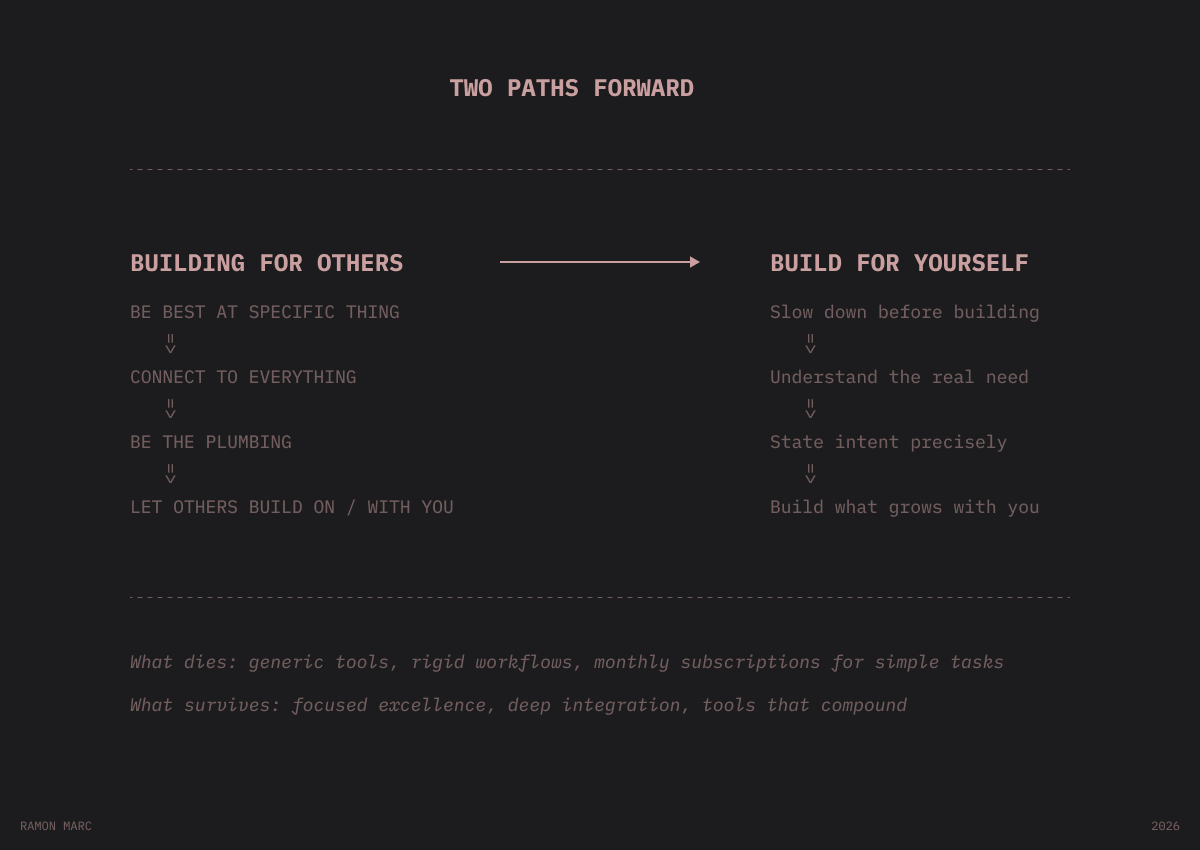
If you build for others: be the best at one thing. Not good at five things. The more universal you are, the easier you are to fork. The platform question changed from “how do we lock them in” to “how do we connect them to everything else.” Be the plumbing. (Protocols over Plattforms (Always!))
If you’re a builder: the discipline isn’t execution anymore. Execution is becoming rapidly cheap and reliable. The discipline is clarity. Understanding what you actually need. Stating intent precisely enough that you build something worth keeping.
Where this goes
Software becomes contextual. Does only what you need right now. Adapts to how you work instead of making you adapt. Agents handling workflows in the background, no UI required. Your tools learn your patterns locally, evolve around you without configuration.
The application era is ending. What replaces it is messier and more personal. We’re in the transition where everyone figures it out by building a lot of garbage and occasionally something that lasts. It’s play before the game.
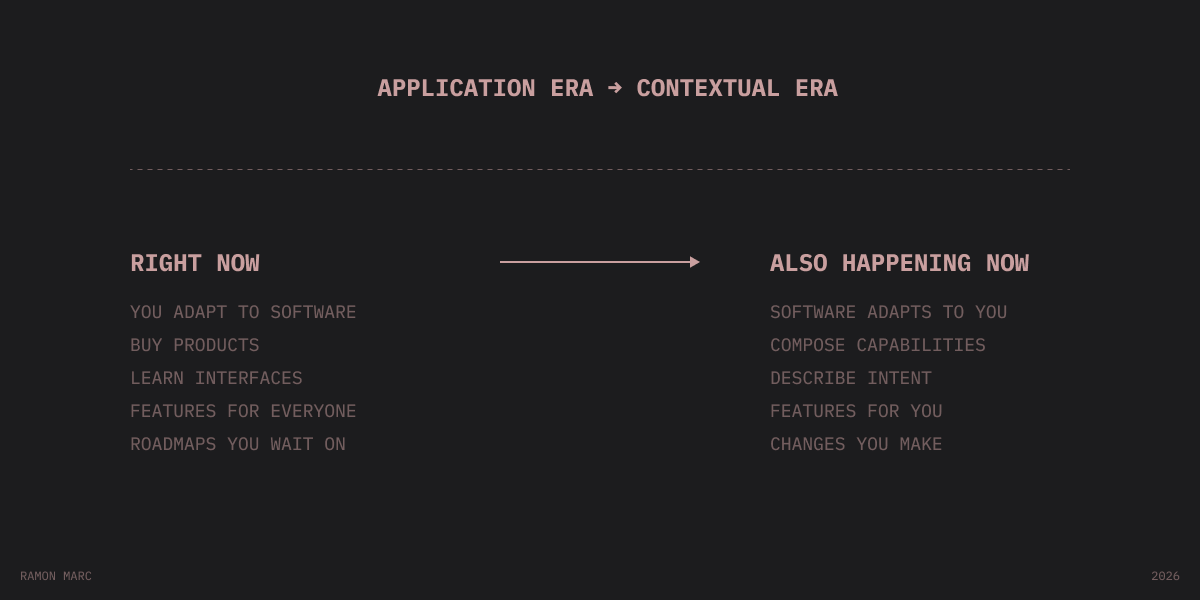
Ask yourself: What would your workflow look like if every tool shaped itself around you? What's stopping you from building that?The rage quit economy is here. Your customers are already in group chats talking about building it themselves.
Look down.
Cheers. RM
This post was written in one session using Claude Opus 4.5 through Quick Capture. I dumped a mess of voice notes, discussion guides, and half-formed bullet points into the context window and we shaped it together through a few editing passes. The ideas are mine, the speed is new. (I did make the frameworks manually though.)
This is so timely! How do you see AI afecting the 'moat' for FOSS? So insightful!