
Teachable UX
It's not just you. Its them too.

Every interface you’ve ever used was designed before you showed up.
Someone in a room decided how you’d see your calendar. How your bank would surface a charge. How many options you’d get when booking a flight. The edge cases. The perfect addictive infinite scroll loop. The micro-copy on the error state. All of it. Decided. Before you existed as a user. The happy ideal key user journey A/B tested path.
That most of the time worked when humans were the ones clicking buttons. But UX was defined by the tyranny of average and mean.
It’s about to stop working entirely.
The Dead Assumption
Here’s what every interaction pattern in the history of computing shares: the human executes the workflow.
Direct manipulation. Search. Feeds. Forms. Conversational UI. Even the stuff we call “AI-native” right now. The user has intent, the user takes action, the system responds.
Agents start to break this. Not in a cute “AI assistant” way. In a structural way. Agents have initiative. They operate across services you never see. They have a heartbeat and more and more agency on your behalf now. They initiate and execute on your behalf in systems that don’t have interfaces — they talk to APIs, smart contracts and other tools and services.
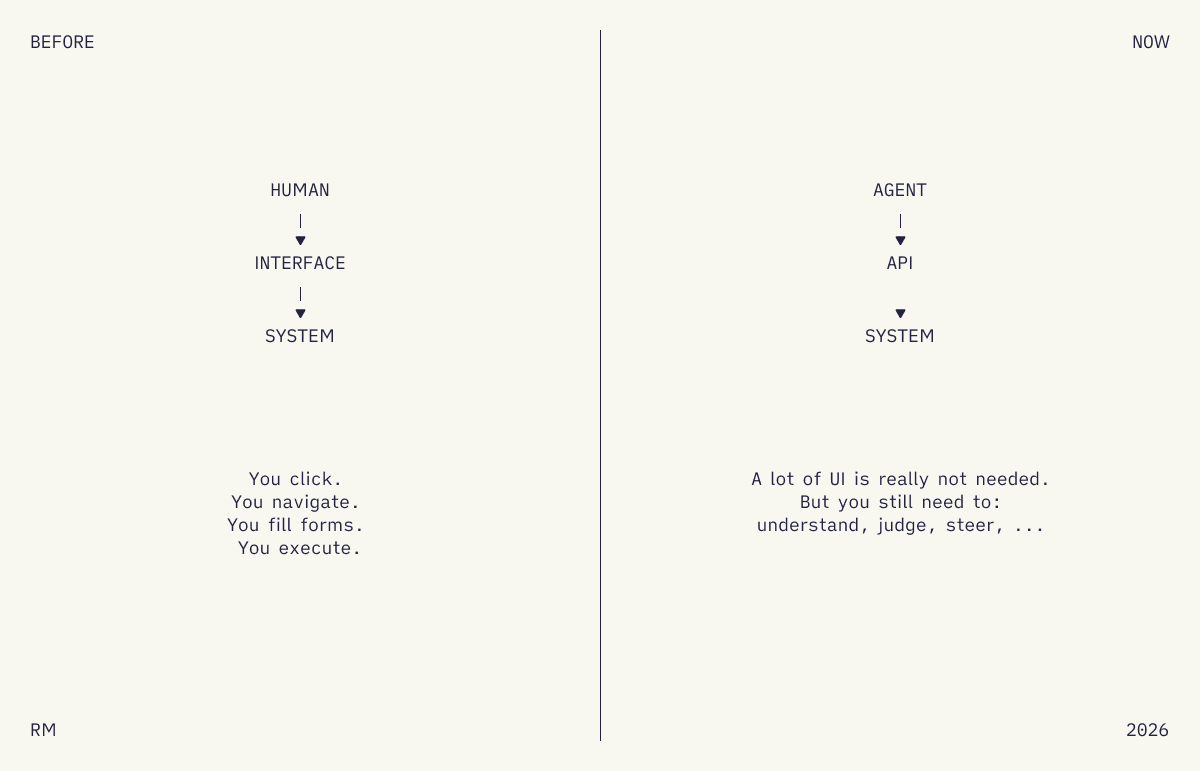
When agents become the primary actors, the entire visual layer becomes vestigial. A leftover from when humans needed to see things to do things.
So what is the interface even for? Is it solely for you? Feel good vanity for the occasional old school user.
The Wrong Question
We are asking: “How do we design better AI interfaces?”
Maybe thats the wrong question. The other question: How does AI learn what interface to generate for you?
That’s probably what’s coming. Thousands of interfaces, generated generatively or procedurally on the fly, by agents acting across every service you touch and intent you formulate. Notifications. Summaries. Decisions. Alerts. All of it — generated. Contextual. Ephemeral.
And right now, all of it is often quite generic. The same density, the same tone, the same card-with-two-buttons for everyone. Or just the default conversational chat flow with AI artifacts in between.
It doesn’t know yet you think in narratives, not tables. It doesn’t know you freeze with too many options. It doesn’t know financial data stresses you out but travel logistics don’t, they even fire you up. It doesn’t care yet that Monday mornings are different from Wednesday afternoons.
Our systems don’t captures this really yet. Settings pages are static and shallow. Behavioral inference is opaque and not yours. “Tell me about yourself” onboarding doesn’t work — people are terrible at describing their own preferences in the abstract before they even are used too.
The Insight
People can’t tell you what they want. But they can react to what they see. Always has been. We are better creative directors realistically than designers. If the internet made one thing for sure is that we all have opinions. =)
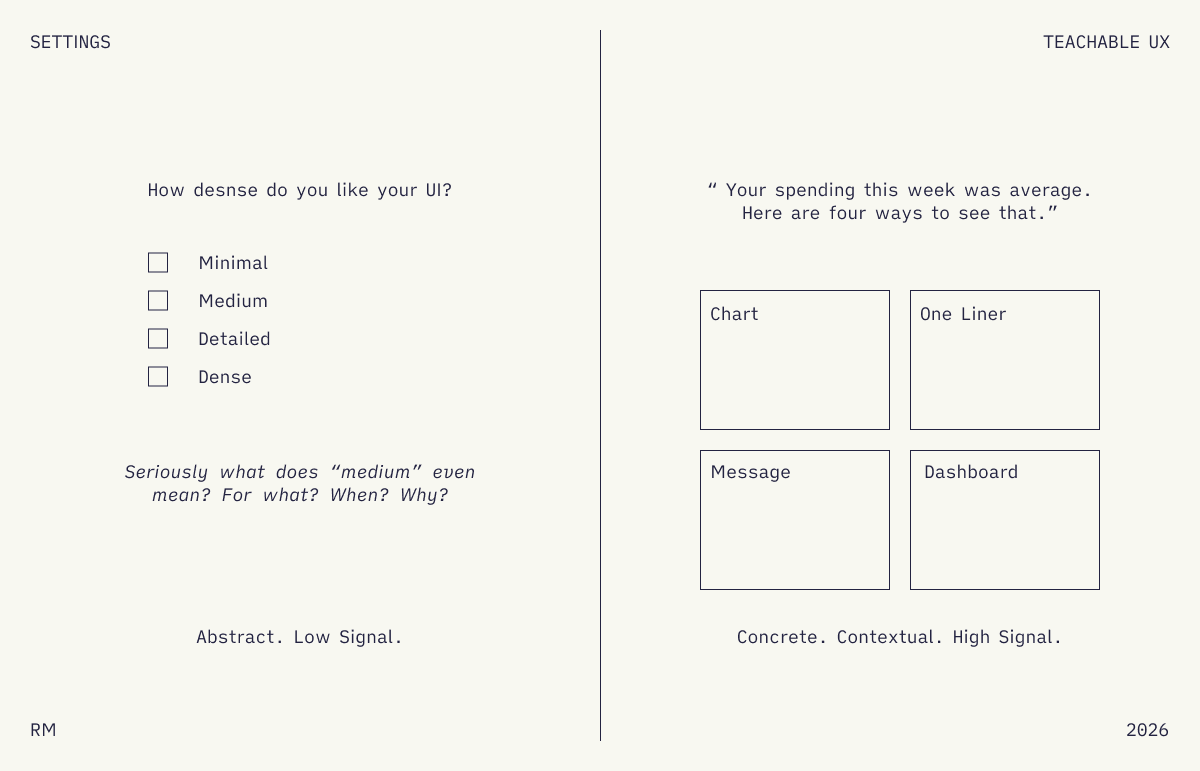
You don’t know you prefer concise financial summaries until you’ve seen a verbose one and felt your eyes glaze over. You don’t know your threshold for delegation until you’ve felt the discomfort of an agent acting without asking.
Feelings are real. Feelings matter. Your feelings are the data.
Teachable UX
Instead of designing interfaces — or having AI guess — what if we train the AI on how to communicate with us. Through reaction, not declaration. Through experience, not configuration.
Show real, rendered interfaces. Let people react. Capture the signal. Build a model.
Not “do you prefer charts or text?” That’s a settings page wearing a costume.
Instead: “It’s Tuesday morning. Your agent handled 4 things overnight.” And you see four genuinely different approaches — a minimal one-liner, a structured list, a warm summary, a rich dashboard. Real typography. Real content. You pick the one that feels right. Or say “between those two.” Or say “that would stress me out.”
Every reaction updates the model. Every session refines it. Duolingo but UNO inverted. AI learns to speak like you.
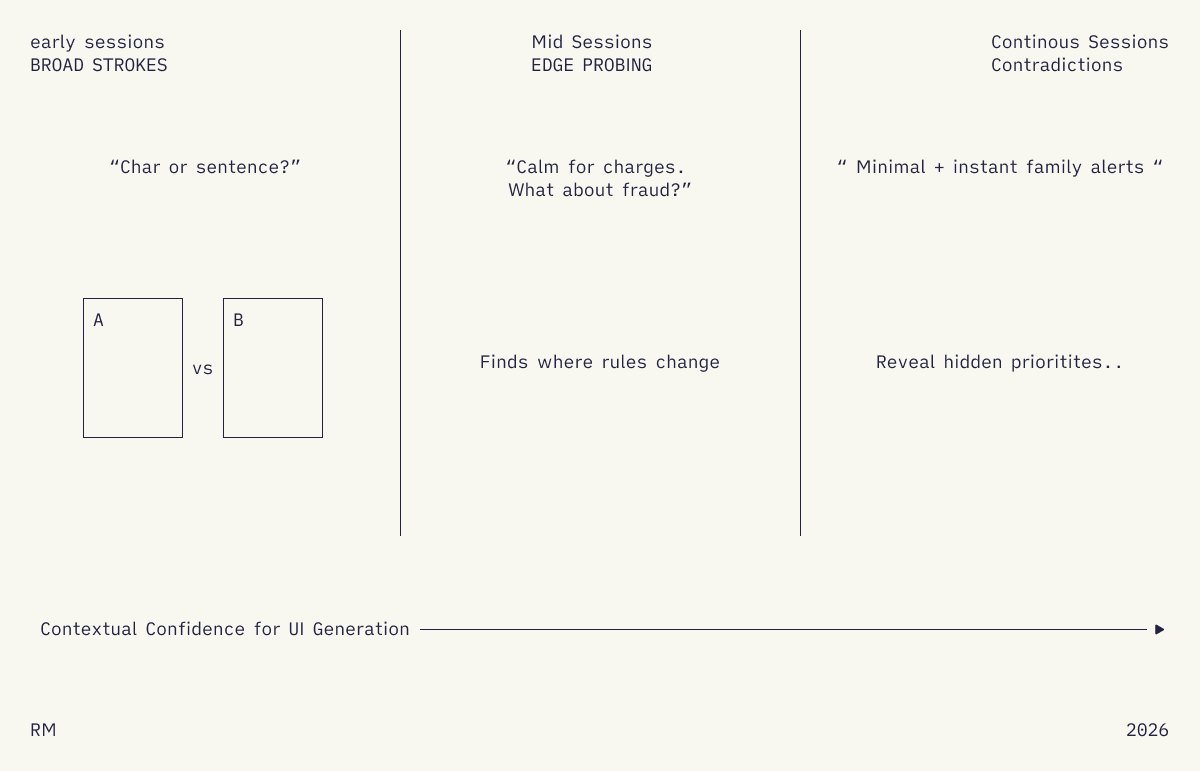
The contradictions are the most valuable moments. They force articulation of priorities you’ve never consciously ranked.
The Model
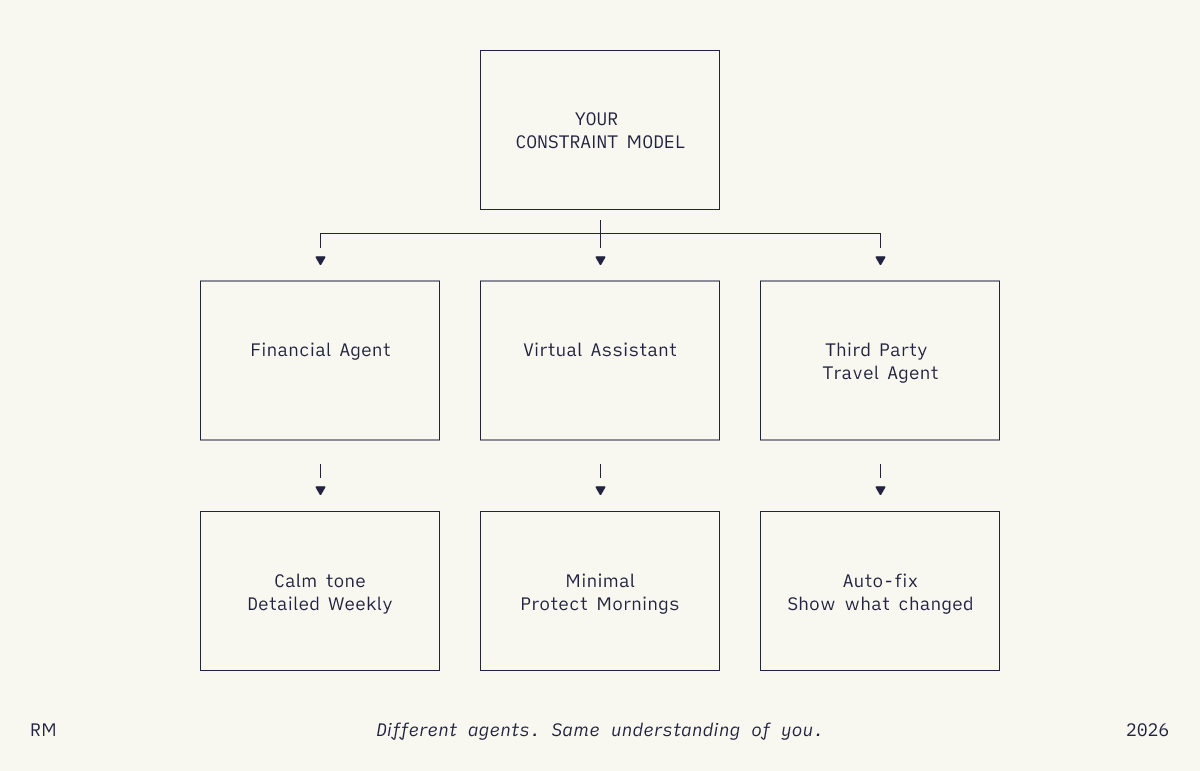
The output ideally isn’t “you’re a Type A communicator.” It’s a structured, contextual, confidence-scored constraint model.
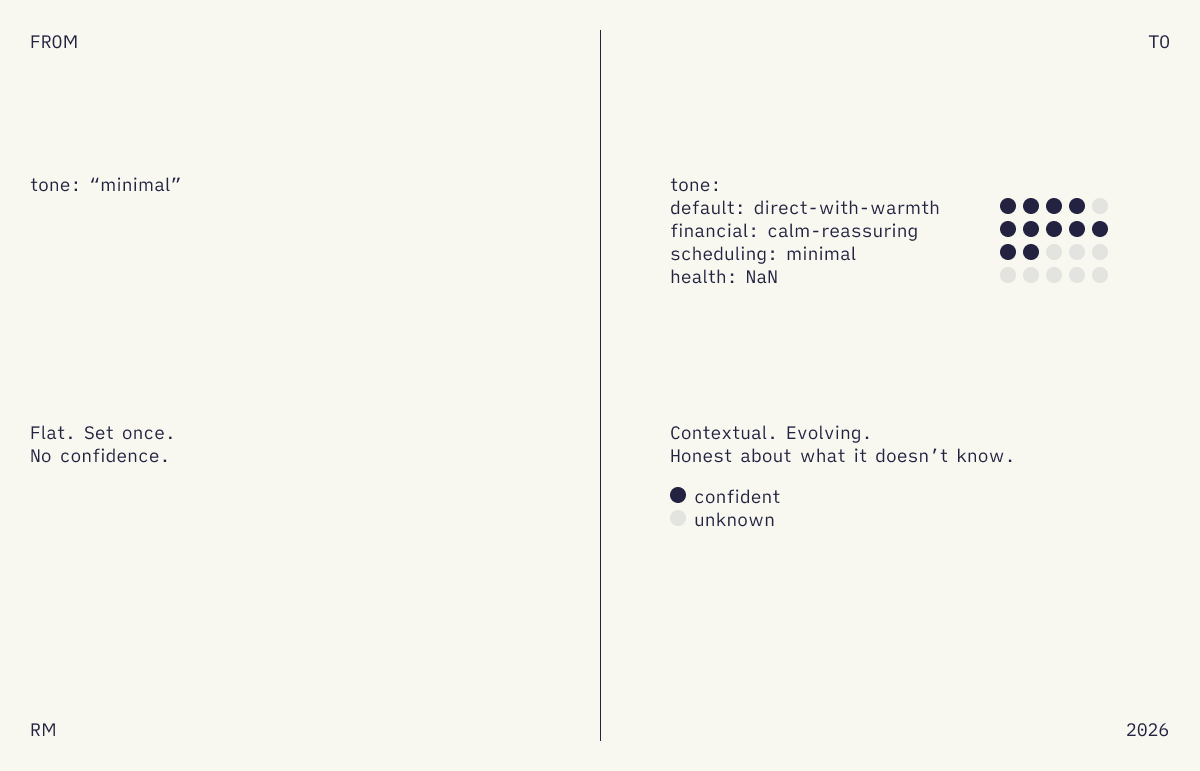
Context is structural, not an afterthought. “Minimal for logistics, detailed for finance, unknown for health.” Preferences aren’t global. They never were.
The model is append-only. It ages like a relationship ages — carries the imprint of every interaction. And it belongs to you. Portable. Exportable. Any AI generating UI for you can consume it.
Think of it as the Accent-Language / YourSoul.md header for your entire interface experience.
The Real Shift
This is a provocation and an early prototype. Hinting at a design paradigm shift.
The designer’s job changes. You stop designing screens. You start designing the conditions under which good screens can emerge for anyone. Component vocabularies. Composition grammars. Texture languages — what “urgency” feels like, what “everything is handled” feels like, consistent across any device, any moment.
Design as world-building. Not the interface. The possibility space of interfaces.
The hardest question might not be about aesthetics or information density. Probably more like: how do you make someone feel in control when they’re not the one doing things?
Every interaction pattern we have assumes control comes from action. Click, tap, type, drag. You do things, therefore you’re in charge. Agents invert this.
The closest analogies aren’t in software. Horse and rider — developing a shared language over time, neither fully in control. Guide dog and handler — including moments of intelligent disobedience, where the dog refuses a command because it sees danger the handler doesn’t.
The trust to let an AI override your stated intent is built through exactly this kind of learning process. Teachable UX isn’t just about how things look. It’s the foundation for how humans and autonomous systems build trust.
We should start thinking about this now. Before the thousand generic interfaces arrive.
Cheers. RM
Rapid Prototype & Concept on a late Sunday for Figma Makeathon
=> Prototype